
Acupuncture for Autism and Adult ADD/ADHD
- Understanding Efficacy in Acupuncture for ASD and ADHD in Adults
- Research on Acupuncture for ADHD in Adults
- Research on Acupuncture for Autism Spectrum Disorder (ASD)
- Nervous System Effects of Acupuncture in Neurodivergent Adults
- Common Benefits Observed in Adult Care
- Acupuncture as Part of an Integrated Care Plan
- Our Approach at Solis Acupuncture
- Getting Started with Acupuncture Support
Interest in acupuncture for neurodivergent adults has grown quickly—especially among adults living with autism spectrum disorder (ASD) and ADD/ADHD who want options beyond medication, coaching, and therapy. Many people are looking for support with the real-life impact of these conditions: nervous system dysregulation, insomnia, anxiety, sensory overwhelm, chronic pain, headaches, digestive issues, burnout, and difficulty sustaining focus.
At the same time, it’s important that we stay honest about the evidence. The research base for acupuncture in ASD and ADHD exists, but much of it is pediatric or has methodological limitations (small sample sizes, variability in acupuncture styles, inconsistent outcome measures, and challenges with blinding). What we do know as clinicians is that patients attest to the benefits time and again. Patients report feeling grounded, focused, calm, and balanced for several days after getting acupuncture treatment. Below is a grounded overview of what the best available research suggests—and how we translate it into responsible, adult-focused care.

Understanding Efficacy in Acupuncture for ASD and ADHD in Adults
First, let’s create a clear framework for how to understand “efficacy” for ASD and ADHD treatment in adults. ASD and ADHD are neurodevelopmental conditions—not infections to “eliminate” or diseases to “cure.” So, when we talk about acupuncture being “helpful,” we’re usually talking about supporting function and quality of life, such as:
- better sleep and recovery
- reduced anxiety and stress
- fewer headaches/migraines and less chronic pain
- calmer sensory processing and reduced agitation
- improved mood stability and resilience
- improved digestion/appetite regulation
- better ability to focus
This distinction matters because a large portion of the acupuncture literature in ASD/ADHD focuses on symptom scales rather than long-term adult functioning, workplace performance, relationships, or burnout prevention.
Research on Acupuncture for ADHD in Adults
Now, let’s look at what the research says about acupuncture for ADHD, and what is missing for adults. Across systematic reviews and meta-analyses, acupuncture is often reported to show symptom improvement in ADHD—commonly measured as changes in hyperactivity/impulsivity, attention scores, and global symptom ratings. But the same reviews consistently conclude that the certainty is low, and that higher-quality trials are still needed.
- A 2021 meta-analysis (largely pediatric) suggested acupuncture may be beneficial compared with stimulant medication on some outcomes but emphasized that the evidence is highly limited with risk of bias and very low certainty.
- A 2023 systematic review focused on children/adolescents found mixed findings and again emphasized that current data do not strongly support routine use due to trial quality issues.
- A 2023 “overview of systematic reviews/meta-analyses” reported that acupuncture might improve certain ADHD-related outcomes, while stressing that better RCTs are needed before drawing firm conclusions.
The reality of the situation with adults is that there is simply not a lot of research on autism and ADHD across the board. Most ADHD acupuncture studies are not truly “adult ADHD” studies—many include children/adolescents or mixed age ranges, and adult-specific conclusions are often described as unclear.
So, what do we do with this as medical providers? We treat the evidence responsibly: we do not position acupuncture as a stand-alone “treatment for ADHD itself.” Instead, we use acupuncture as a nervous system and symptom-support therapy that can make it easier for adults with ADHD to benefit from their core supports (medication when appropriate, therapy, coaching, exercise, nutrition, and structured routines).
Research on Acupuncture for Autism Spectrum Disorder (ASD)
Let’s now look at what the research says about acupuncture for autism (ASD) and why adult evidence is again limited. Research on acupuncture for ASD has increased, with systematic reviews examining RCTs and controlled clinical trials—again, mostly in children.
- A 2018 systematic review suggested acupuncture may be effective and safe for pediatric ASD, but noted the findings were not conclusive due to heterogeneity in interventions and study designs.
- A 2021 literature analysis and evaluation reviewed acupuncture studies for ASD and discussed potential effectiveness and safety, while reflecting the broader limitation that trial quality varies considerably.
- A 2023 meta-analysis in PLOS ONE examined RCTs of acupuncture and behavioral therapy approaches for ASD-related outcomes (again, largely pediatric) and highlighted the need for stronger methodology.
- Reviews continue to emphasize that research methods and outcome measures vary widely across trials, limiting certainty and making it difficult to generalize.
There is far less high-quality research on acupuncture specifically for adult ASD outcomes. That doesn’t mean acupuncture can’t be helpful—it means we should avoid overclaiming, and focus on what we can support with better confidence: sleep, stress physiology, pain conditions, headaches, GI symptoms, and emotional regulation.
While ASD and ADHD are complex and multifactorial, acupuncture is widely studied for effects on the nervous system, including stress regulation, autonomic balance, and symptoms like anxiety and insomnia. For example, controlled trials in anxiety show strong evidence that acupuncture can reduce anxiety scores in adult populations.
Nervous System Effects of Acupuncture in Neurodivergent Adults
For neurodivergent adults, that matters because executive function, attention, sensory processing, and emotional regulation often worsen when the nervous system is stuck in high-alert mode (poor sleep, chronic pain, inflammation, trauma stress, hormonal shifts, weakened immunity, workload burnout). When sleep improves, and physiologic stress load decreases, many people report they can think more clearly and function more consistently—even if their underlying neurotype doesn’t change.
Common Benefits Observed in Adult Care
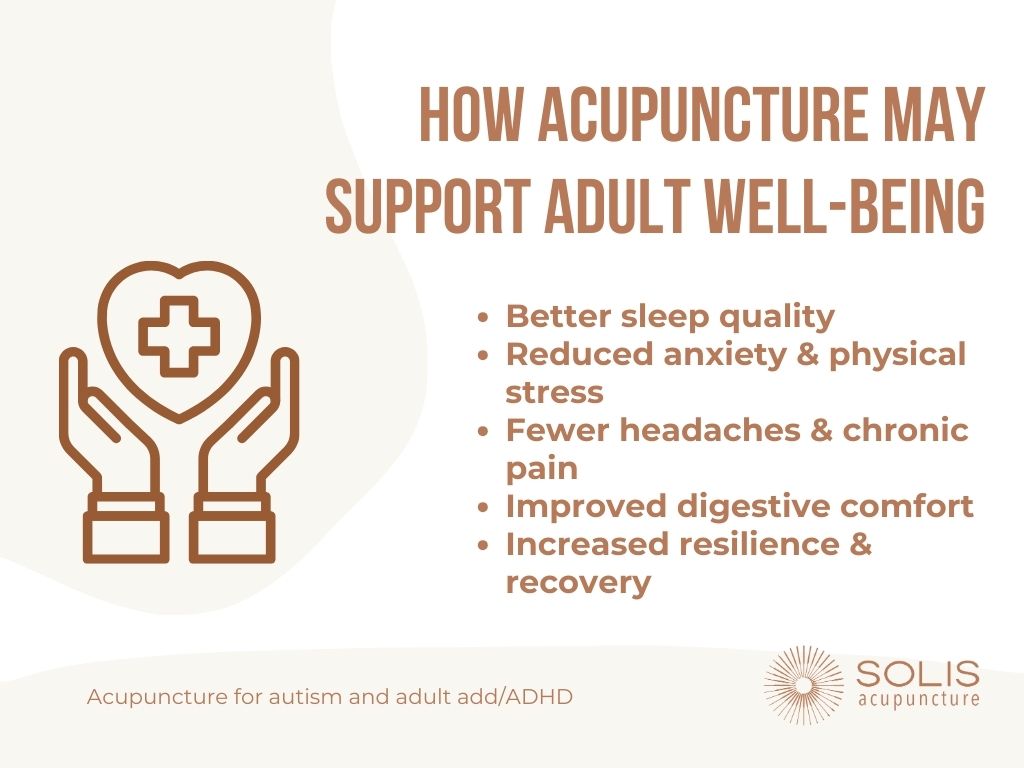
In real-world adult care, the most common “wins” we see acupuncture support (when it’s a good fit) include:
- Sleep improvement (falling asleep faster, fewer awakenings, deeper rest)
- Reduced anxiety / somatic stress (less muscle tension, less chest tightness, fewer stress spirals)
- Fewer headaches and less chronic pain
- Improved digestion (less IBS-like reactivity in some people)
- Improved resilience (less burnout, better recovery after overstimulation)
Acupuncture as Part of an Integrated Care Plan
We also believe it’s important to say clearly: acupuncture is not a replacement for diagnostic care, therapy/coaching, workplace accommodations, or medication decisions. It’s best viewed as part of an integrated plan.
Our Approach at Solis Acupuncture
At Solis Acupuncture, we specialize in evidence-informed pain care and nervous system regulation. We work with many adults who identify with ASD, ADD, and ADHD traits—especially those dealing with the secondary impacts: chronic tension, migraines, TMJ, neck and back pain, insomnia, digestive dysregulation, and anxiety/burnout. Here is what makes our care unique-
- We match treatment plans to the person’s sensory profile and stress physiology (not a one-size-fits-all protocol).
- We emphasize a calm, respectful, low-pressure clinical environment.
- We integrate acupuncture with manual therapies when appropriate, and we educate patients so they understand what we’re doing and why.
Getting Started with Acupuncture Support
If you are exploring acupuncture as an adjunct for ASD and/or adult ADHD support, we can help you build a plan focused on measurable quality-of-life outcomes—sleep, pain, stress load, and functional resilience—while keeping expectations aligned with what current research supports.
To get started, we recommend scheduling a consult so we can understand your goals, current supports, sensitivities, and health history—and then design a plan that’s both compassionate and clinically grounded. Each of our providers at Solis has the highest level of education and clinical expertise to meet your body’s unique needs. We are in network with most major insurance companies, including Kaiser and Sutter, and we have appointments in the evenings and on weekends at both our Capitola and Scotts Valley offices. Simply give us a call, and we will get you on the schedule!

